
Text By Michael Burdi
For Kaveh Haghtalab, music has never belonged neatly to a single genre.
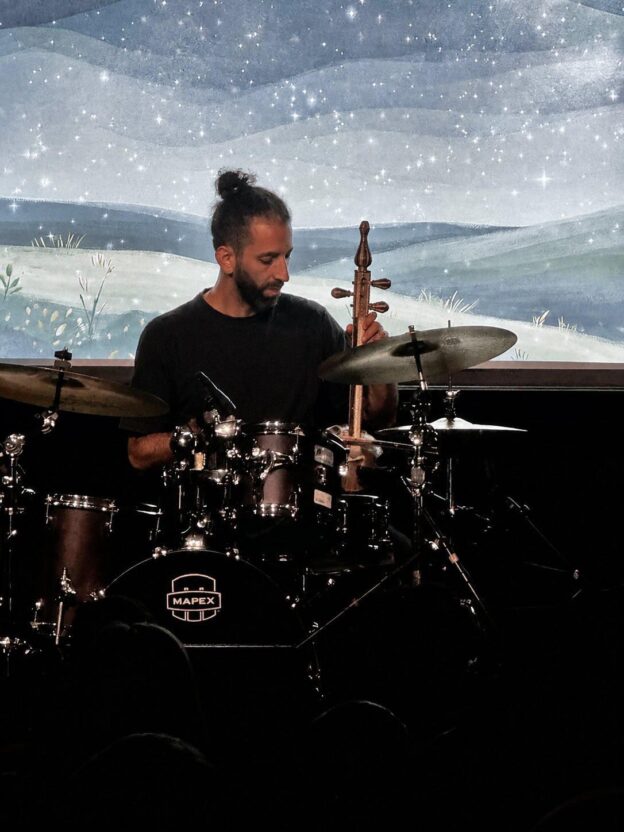
 Before moving to the U.S., Kaveh Haghtalab worked as a professional musician in Tehran, performing as a kamancheh player and drummer in concerts, festivals, theater, film, and radio. He spent years immersed in Persian classical and regional traditions. Seeking greater cross-cultural exposure and collaboration, he moved to New York. He attended The Collective School of Music, originally known as Drummers Collective, where he studied jazz, Latin, pop, blues, and rock—all of which became part of his musical vocabulary.
Since relocating to New York, Haghtalab has performed, toured, recorded, composed, and arranged across a wide range of projects. Years of study, listening, and playing alongside musicians from different backgrounds gradually changed how he heard music.
While he retains deep roots in Iranian/Persian music, Haghtalab does not see these influences as separate worlds that need deliberate combination. This differs from simply deciding to “fuse” Iranian music with jazz, African music, or Latin rhythms. Instead, he sees them as accumulated experiences that shape an artist’s voice.
That distinction is central to his approach to arranging.
Tradition Does Not Need to Be Modernized
For many years, discussions around non-Western music have sometimes used characteristics of Western classical music—large orchestras, harmony, notation, and certain forms of musical structure—as markers of sophistication or progress.
Haghtalab rejects the idea that traditional or regional Iranian music needs to be “modernized.” Iranian classical and regional music developed within their own cultural, historical, and musical contexts. They have their own systems of expression, complexity, rhythm, phrasing, and improvisation. Judging one musical tradition entirely by another’s standards can obscure what makes that tradition distinctive in the first place.
This philosophy shapes the first question he asks when arranging an older Iranian song: Is the element he adds genuinely part of his own musical language, or is he adding it because he assumes music is supposed to sound a certain way?
For Haghtalab, Western harmony, contemporary instrumentation, rhythmic structures, and other non-Iranian/Persian musical devices have value. In this context, however, they must come naturally from the arranger’s musical experience.
Learning Music as a Language
Haghtalab often compares learning a musical tradition to learning a spoken language. Hearing and reproducing the basic patterns of a musical form or tradition has limited value on its own. Spending years listening to that music, studying it, performing it, and understanding how musicians within that tradition feel and interpret its elements is something entirely different.
Knowing a few words does not mean a person speaks a language. Similarly, borrowing a few elements from another musical culture does not necessarily create meaning or authenticity.
For Haghtalab, an outside influence should not function merely as decoration. It must be internalized deeply enough to become part of the musician’s instinctive vocabulary.
That belief comes partly from his own experience. The kamancheh and drums have taught him two very different ways of hearing music. The kamancheh connected him to Persian melody, phrasing, ornamentation, subtlety, and the expressive language of Iranian music. Drums brought him closer to rhythm, movement, interaction, and groove. Both perspectives shape his approach to making music.
Rhythm as a Living Entity
People often discuss Persian music primarily in terms of melody. Haghtalab, however, is equally immersed in its rhythmic history. Older Iranian musical traditions contain complex rhythmic cycles and structures, while rhythm also plays a central role in many of Iran’s regional traditions.
What particularly interests him is that musical time does not always need to behave mechanically. A phrase can expand or contract, and the pulse can move slightly forward or backward while maintaining an underlying internal order.
Haghtalab compares it to a heartbeat. A heartbeat has rhythm, but it is not a metronome. It is organized, yet alive.
He tries to preserve that sense of rhythm as a living entity, even in contemporary arrangements.
Songs as Collective Memory
This philosophy matters most when Haghtalab works with regional songs such as “Rashid Khan,” “Mastom Mastom,” or “Asemoon.”
These songs have passed through generations. Families and communities have heard and sung them, connecting them to memory long before a contemporary musician begins arranging them.
Haghtalab believes that collective memory is about more than melodies. It is something worth preserving.
An arrangement may change the instrumentation, rhythm, form, or harmony, but the song’s essence must remain. It must reconnect the listener to the memory carried by the original.
The goal is neither to reproduce the past exactly nor to replace it. It is to continue the story and carry forward the experiences of previous generations, allowing the song to pass through another life, another set of experiences, and another musical language.
Koubeh and a Contemporary Voice
Koubeh is a New York-based Iranian ensemble. Formed in 2019, it centers on three musicians from the Iranian diaspora: Haghtalab, Sima Shahverdi on vocals, and Nima Farzaneh on accordion and keyboards, plus guest musicians. The ensemble is one place where Haghtalab puts these ideas into practice.
The band draws on Iranian regional melodies and songs, using instrumentation that may include accordion, guitar, bass, and drums. Rhythmic ideas can emerge from the broader musical experiences of the musicians themselves.
But the purpose is not to demonstrate how many genres can fit into one arrangement.
For Haghtalab, if the final result feels forced, the combination has failed.
All of those influences eventually have to become one musical voice—one that reveals where the music comes from while also belonging to the musicians performing it today.
“Asemoon” is one example of this process, but the same thinking appears in other Koubeh arrangements, including “Rashid Khan” and “Mastom Mastom.”
The philosophy also extends beyond traditional music to original material.
Haghtalab’s original composition “Gonjeshk” begins from a different place because it is not based on an older song, yet the same musical experiences remain present. With a traditional song, the process begins with a shared memory and adds an individual voice. With an original composition, the process begins with the individual voice—but that voice is made from everything the artist has lived through.
For Haghtalab, this may be the simplest definition of artistic honesty: refusing to force the music to become something it is not, while embracing the experiences that have shaped the person creating it.
In addition to his work as a performer, composer, arranger, and bandleader, Kaveh Haghtalab is a member of the musicians’ rights organization Musicians For Musicians, Inc. (MFM), where he learns more about the business side of making music and advocates for musicians’ rights with fellow members.