DBDBD NY – cross-cultural on-line magazine – believes based on the view that music and community are indivisible that a social awareness can be fostered through music.
I would like to introduce you to BreakThru Radioin NYC. BTR Live Studio produces a number of music-based web programs and features a mix of breaking and established musicians. All music is played exclusively by the bands.
This time New York City’s afro-beat 10-piece groupEMEFE stops by in their studio performing “Good Future”, and chat with the host Maia Macdonald – who’s a musician and DJ and has been involved with the music scene for a number of years – about their band name and the positive philosophy behind the project.
Date: February 2, 2013 Location: the Cooper Union Foundation Building
Text by Dawoud Kringle
On a moderately cold Cooper Union’s Great Hall was packed with everyone who is connected with the NYC jazz and poetry scene to pay tribute to the late master poet Jayne Cortez.
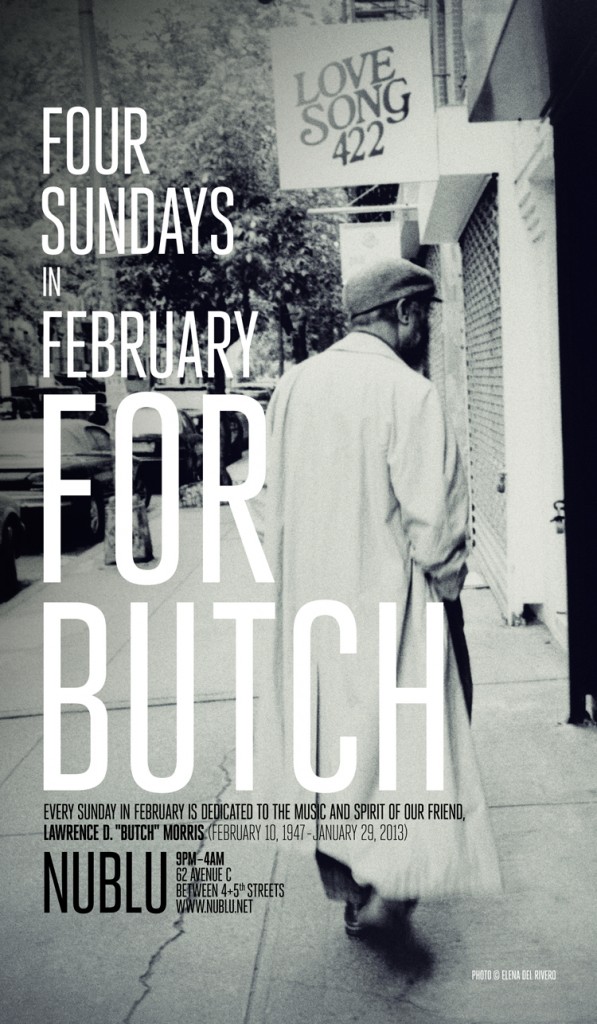
The world lost an outstanding and original musician yesterday when conductor, composer, cornetist, educator, and writer Lawrence “Butch” Morris passed away a few weeks shy of his 66th birthday. Morris got his start as a cornetist in the ’70s, playing with saxophonist David Murray, and others, but is best known for his conductions, live conducted improvisations of often large ensembles, in which he created compositions in real time by directing musicians (and/or poets) with a set of several dozen hand signs and gestures. Morris developed this system (which he has described as an exploration of the overlapping space between improvisation and composition) as an outgrowth of an attempt to devise a more flexible musical notation.
Over a 25+ year span, Morris taught and conducted over 5,000 musicians in 200 or so conductions in New York, Europe, South America, and Asia; often the concerts followed intensive workshops. Morris also wrote about his conduction and musical philosophy in a complex, information-rich style that reminds me of none other than R. Buckminster “Bucky” Fuller, inventor of the geodesic dome. In addition, Morris had, from time to time, some ongoing projects which included the Chorus of Poets, the Lucky Cheng Orchestra, and the Nublu Orchestra.
Last night I went to see my buddy’s show who introduced me after his show to the guitarist and “Global Soul Artist” producer Tomás Doncker.
Chatting with him I found out that he lived in Tokyo for a while working with the Japanese jazz musician Masabumi Kikuchi, that he loves Ethiopian music like I do, and that he collaborated with producer and musician Bill Laswell on his new CD. I have been knowing Bill Laswell for three decades. I met him for the first time in Osaka (Japan) in the mid seventies when he played with Toshinori Kondo (trumpet), Peter Kowald (bass), Hano Koji on drums. At that time I couldn’t imagine that Bill would become as a producer and musician an icon of dub and world music. His Ethiopian wife Gigi (read post below) whom I’m a fan of is also appearing on Doncker’s CD.