
Winchell: The Musical – A Noisy Empire That Came To A Silent End
Review by Dawoud Kringle
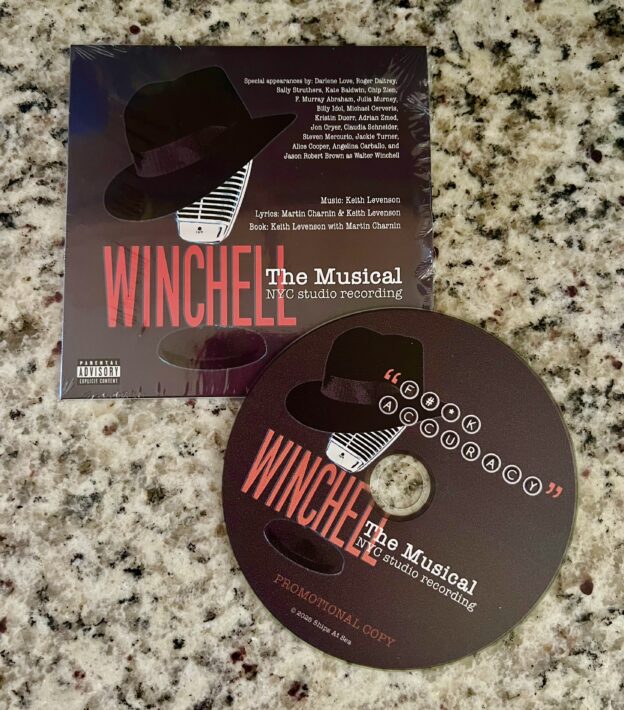
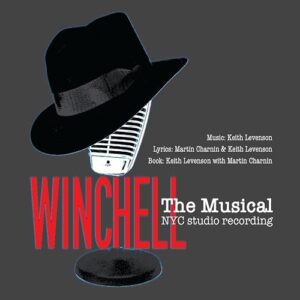 Keith Levenson‘s resume is a veritable who’s who of the music business, spanning from Annie and Dreamgirls to working with The Who and the London Symphony Orchestra. Now, from his home studio and as a Parkinson’s patient at the Cleveland Clinic, he has undertaken his most personal project: resurrecting Winchell, the 1991 Broadway musical that MFM member Levenson co-wrote with Martin Charnin (Annie). This new recording, featuring a stunning roster of guest artists like Roger Daltrey, Alice Cooper, Billy Idol, and Sally Struthers, is more than a cast album; it’s a benefit for the Cleveland Clinic Lou Ruvo Centre for Brain Health, a cause Levenson knows intimately as both a patient and a volunteer.
The subject, Walter Winchell, was the most influential news personality of the 1930s and 40s. He invented and pioneered the blend of news and gossip. Levenson’s score does not merely accompany this story; it embodies it. He has composed the sound of a headline. The music is a masterclass in pastiche, evoking the sounds of Gershwin and Porter but consistently subverting them to reveal the moral compromises at the story’s heart. The masterful orchestration is brilliantly telling, using snare drums, brass stabs, and chugging tonic/dominant harmonies to become the sound of Winchell’s life and the pounding pressure of the news cycle itself.
The musical opens with a prologue announcing Winchell’s death, immersing us in a bygone era whose passing is met with more relief than mourning. This sets the stage for the score’s central tension: the exuberant, often upbeat music sharply contrasts with the tragic life of its protagonist.
Tracks like “Winchellese” illustrate how the columnist used his private slang to influence culture, while “Real Good Guy To Know” presents Winchell’s own voice—a caustic man trying to sell himself as someone to be admired. The darker aspects of his character are revealed in “Teacher Teacher,” which details his petty, vindictive destruction of Josephine Baker’s career, and in “Unspoken Symphonies,” which links his abuse of power to his incapacity for meaningful relationships.
Stream here: https://open.spotify.com/album/3xOMijETw2St6Gtg1YSLcF?si=ZI3LnJIgSY2ug440WRqYXw
Levenson proves himself a master of the Broadway art form, using music to tell sophisticated stories. The relentless, staccato delivery of Winchell’s famous radio style is framed by Levenson’s cleverly incorporated non-musical sounds, such as the urgent tapping of a telegraph key that opened Winchell’s broadcasts, to heighten the visualisation.
Ultimately, the score succeeds not through hummable tunes alone, but through its clever lyrical density and dramatic orchestration to paint a complex portrait of its infamous protagonist. While the recording stands on its own, its true power is in making the listener feel the tragedy of Walter Winchell—a man who built his empire on noise, but whose soul is defined by a haunting silence.
Winchell: The Musical is a compelling and thought-provoking work. More importantly, its release supports a vital cause. Levenson and his wife, Betsy Wilkowski, have organised a fundraiser, Stars Unite for Parkinson’s Relief. You can learn more and support the effort here: https://gofund.me/ab0ebf56a.