


Album Review by Dawoud Kringle
Artist: Kevin Keller
Title: Arcade
Label: self-produced
Genre: New Age/Medieval Ambient/Modern Classic
You can listen to the whole album at https://www.kevinkeller.com/
Kevin Keller is an American composer, recording artist, and member of MFM. He calls his work “ambient chamber music”, which combines live instruments with electronics. Out as a guitarist in his teen years, Keller concentrated on the piano, having been inspired by Claude Debussy, Brian Eno, and Harold Budd. During this time, Keller composed ballet scores and chamber music, including a string quartet that premiered by the Kronos Quartet at the 1986 Festival of New American Music. Keller later studied film scoring at the University of California, Berkeley School of Music.
Keller released his first solo recording, The Mask of Memory, in 1994. Radio producer Stephen Hill included several tracks on a program titled Digital Planet in 1995. This was followed by a Living Room Concert and a feature on Echoes, hosted by John Dilberto. Since then, Keller has released 13 full-length recordings and several EPs and compilations, collaborated with cellist David Darling, guitarist Jeff Pearce, and Keller’s own chamber ensemble, which features strings, woodwinds, percussion, and piano, as well as several choreographers. His 2012 album “The Day I Met Myself” won the ZMR Music Award for Best Neo-Classical Album of 2012. The follow-up album “La Strada” won the ZMR Music Award for Best Neo-Classical Album of 2015. Keller’s 2021 album “Shimmer” was named CD of the Month for October 2021 on the syndicated radio program Echoes.
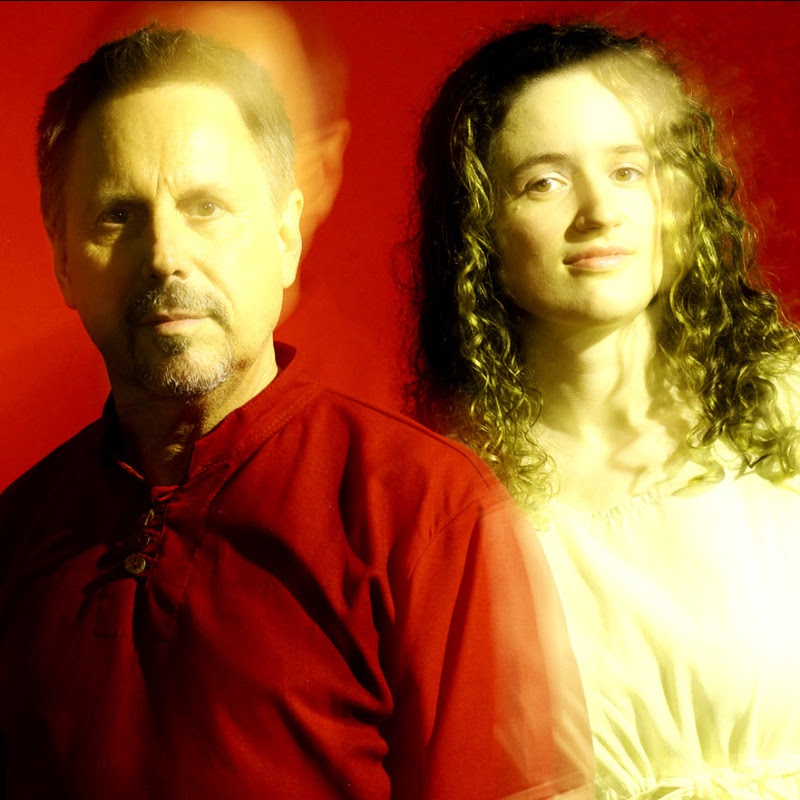
On the sequel to Evensong (2023), his newest album, Arcadia, features performances by Sofía Campoamor (lead vocals, who also composed Plainchant on tracks 3, 5, and 7), Katherine Wessinger, Danya Katok, and Wendy Baker (sopranos), Sarah Zun (violin), Angela Pickett (viola), and Laura Metcalf (cello).
The album opens with Arcadia 1: Et vidi caelum. The title translates as “And I saw the sky.” Campoamor begins with a lovely melody in F# minor. The sopranos and strings ease in, with Metcalf’s cello gently pushing the momentum of the piece. The overall effect is like a 21st-century reinterpretation of the work of Hildegard Von Bingham.
This is followed by Arcadia 2: Et nox ultra (“And the Night is Over”). Campoamor’s vocals waltz on top of Keller’s ARP synthesizer-inspired ostinato in G major. The pattern moves through other choral structures, offering a perfect level of contrast without ever shattering its diatonic dreaminess. It’s rather ingenious how Keller creates the most startling change using the relative minor key against the mood of the piece. This is, strictly speaking, not a drastic deviation, but Keller uses it with brilliant effectiveness and sublimity.
Campoamor and Keller’s compositional collaboration, Arcadia 3: Me solum me invenio (“I Find Myself Alone”) shatters the free-spirited joy of the previous piece. Here, Campoamor’s lovely soprano paints a mournful lament against the seamless blend of Keller’s dark synthesizer and the string section.
Arcadia 4: In Tenebris (“In the Dark”) begins with a minimalist piano and string parts that appear and disappear like phantoms in a mist. The vocals are accompanied by haunting melodies that amplify the mysterious and almost spooky mood. This piece uses A minor to lull the listener into a trance. Then shatters it with delightfully startling modulations before insinuating a haven in the original key. The piece undergoes further changes and concludes in Bb minor, almost defying the expectations set by its beginning.
The rest of the album is just as ingenious and evocative. On Arcadia 5: Mare, littus, flammam (“The Sea, Beach, Flame”), Campoamor and Keller evoke sitting around a fire on a beach at night. Arcadia 6: In Equo Fugit (“He Flees on Horseback”) is a fairy story in C minor. Arcadia 7: Et lux perpetua (“And Eternal Light”) takes the listener into ethereal realms. Arcadia 8: Veni intus (“Come Inside”) ties the entire collection together and finalizes the end with an insinuation of a new beginning.
The entire album is a sublime work of art. This is music that demands total immersion of one’s consciousness. The delicacy of the vocals and instruments conceals a tremendous power and depth of meaning. Keller has masterfully drawn upon the archaic traditions of medieval music and brought them to life in a 21st-century context, without sacrificing the almost lost secrets of our musical ancestors.