
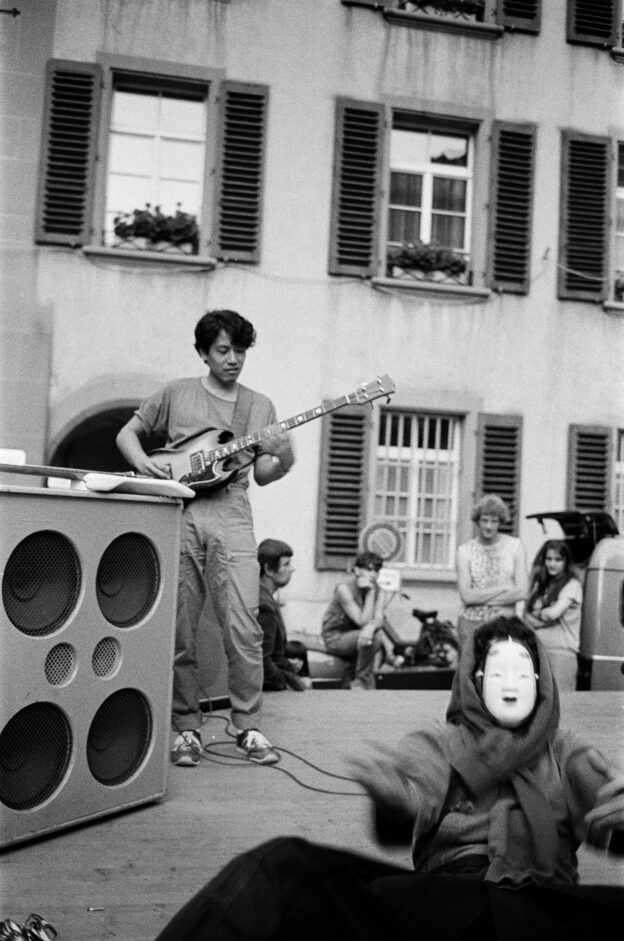

What the Hell are They Doing? SoSaLa Presents another Retrospective.
CD Review by Dawoud Kringle – Photos by Dominique Uldry
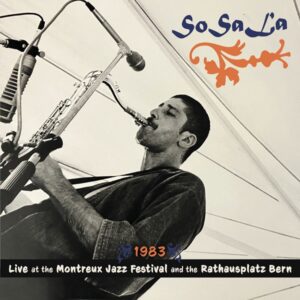 Artist: SoSaLa
Title: 1983 – Live at the Montreux Jazz Festival and the Rathausplatz Bern
Formats: CD and digital download
(An autographed, numbered, and 24-bit high-resolution mastered limited edition of 100 CDs)
Cat.# / Label: DBDCD005 / DooBeeDoo Rec UPC Code: 199800000584
Stream here: https://soundcloud.com/sohrab-saadat-ladjevardi/sets/1983-live-at-the-montreux-jazz-fest-rathausplatz-bern
Buy here: https://doobeedoobizllc.thrivecart.com/sosala-1983/
Those of you who follow SoSaLa‘s musical career will know that in recent years, he has released, or re-released, retrospective recordings. These were from the 80s and 90s. These were particularly productive years for SoSaLa, who went by the name Sadato.
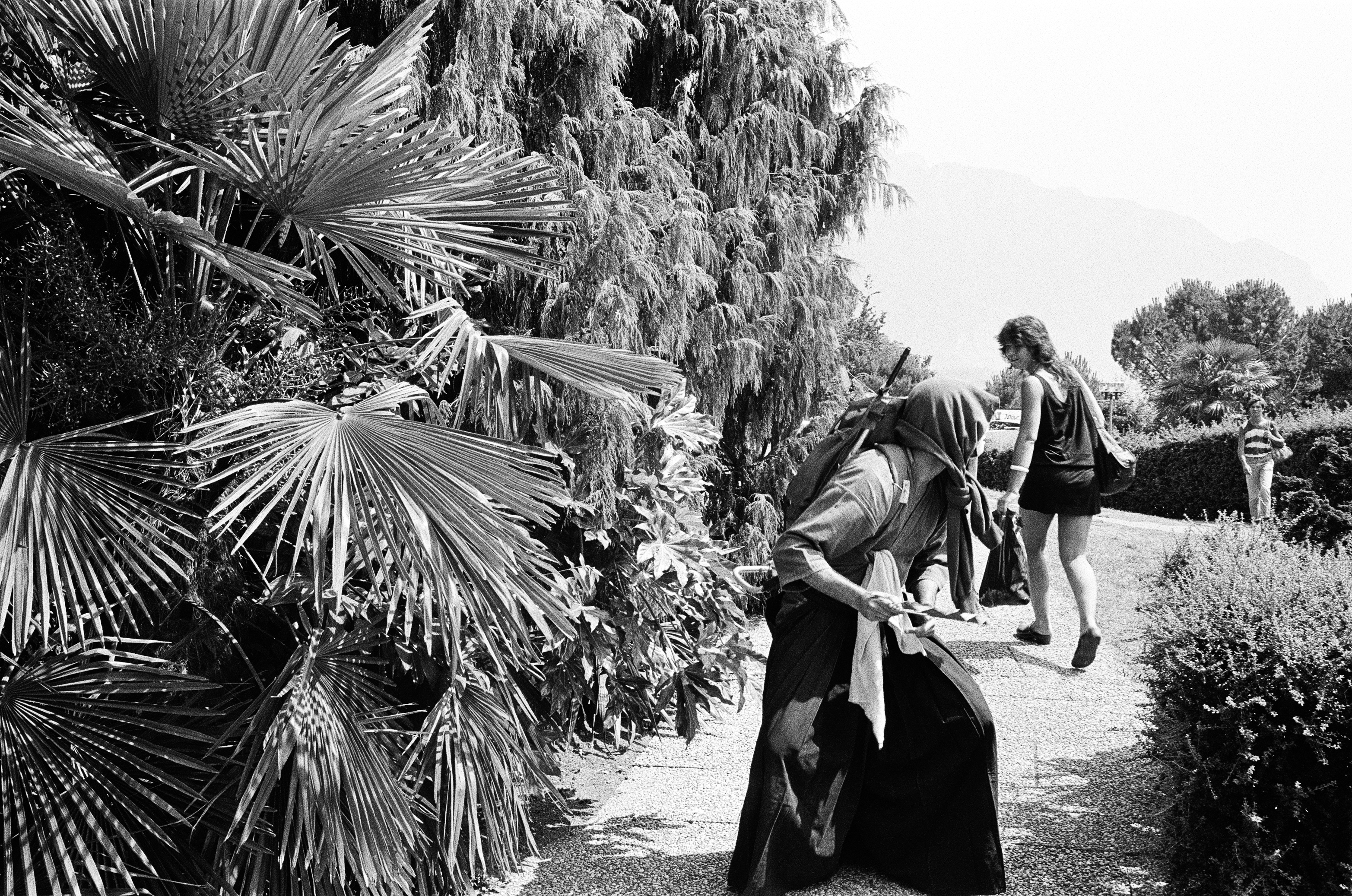
Sadato is performing on his way to the stage.
This collection was recorded live on two dates: July 18, 1983, at the Montreux Jazz Festival, and July 14, 1983, at the Rathausplatz in Bern, during the band’s tour of Switzerland. Claude Nobs, the founder and music director of the Montreaux Jazz Festival, personally invited SADATO GROUP to perform.
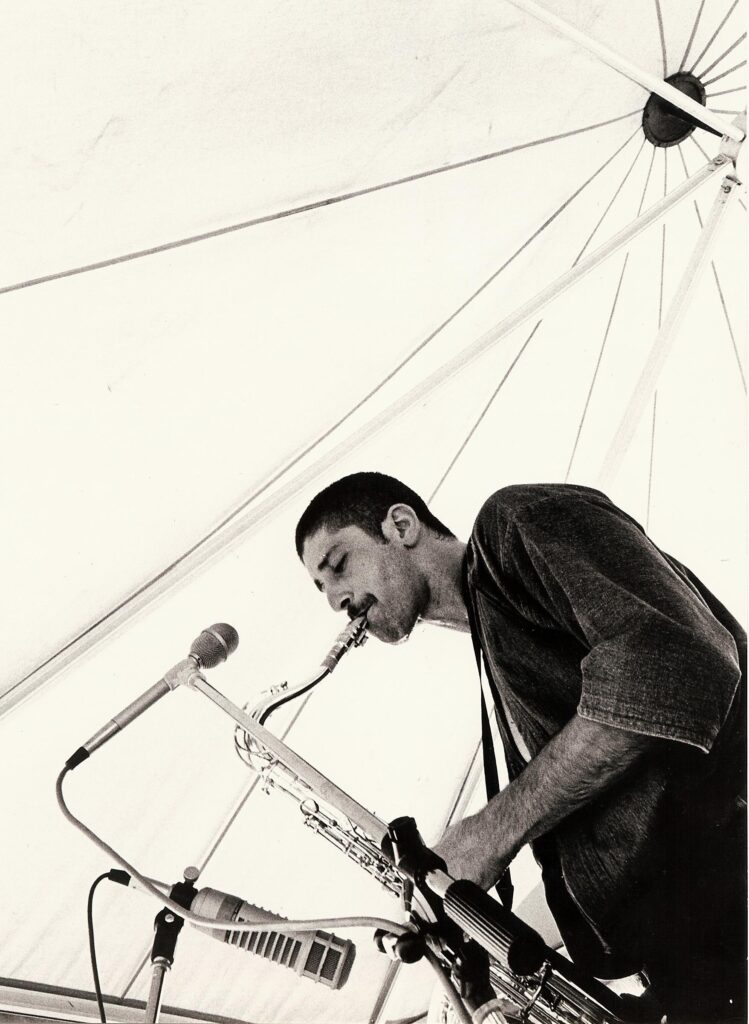
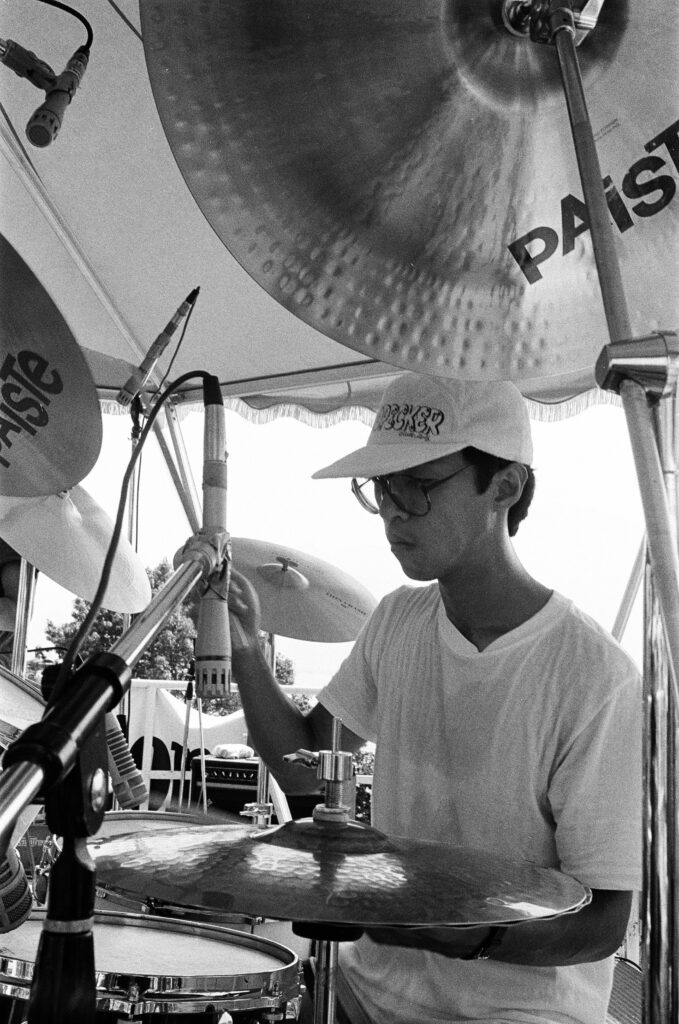
On these dates, SADATO GROUP featured Sadato on saxophone, Rhodes, and harmonica, Mutsuhiko Izumi on electric guitar and electric bass, and drummer-pianist Hitoshi Usami; the group he’d formed two years earlier in Osaka.
Sadato met them for the first time in 1981 at their “free jazz noisy duo gig” at his favorite jazz coffee shop, Cole (named after John Coltrane) in Osaka-Ibaragi City. He liked what he heard and invited them to a rehearsal. After rehearsing several times, they formed a band with Sadato as the leader and composer, and named it after him, the SADATO GROUP. They played mainly in Osaka, but to reach a bigger audience, they gigged in Tokyo every three months.

It’s essential to recognize the innovative and unprecedented nature of the SADATO GROUP at the time. Nobody did what they were doing. They became known for blending elements of alternative rock, free jazz, noise, and sometimes experimental sounds. This set them apart in the Japanese indie rock and jazz music scenes. Sadato had a reputation that bordered on the notorious in Japan. He became a notable figure in the Japanese free jazz and indie rock scenes due to his saxophone work, multimedia stage performances, and multilingual abilities (English, German, Japanese, and Farsi). SADATO GROUP was the only band blending elements of (free) jazz, rock, and Middle Eastern 6/8 and modes into its performances. Sadato’s interesting and accomplished music career virtually created the Japanese free jazz-punk noise scene. No band in Japan sounded like SADATO GROUP. Perhaps nobody ever will.
The year before, they recorded the album In The Woods of Japan. Although it was never released, SoSaLa plans to release it. In 1984, they released the 7-inch plexi single SADATO GROUP Kafesho + Gohon Gahon on the Osaka indie label Kangan Rec.
The first five tracks were recorded at the Montreux Jazz Festival.
The album opens with “Confusing World.” Izumi creates abstract sounds on his guitar. From this emerged Usami playing chords on a keyboard. It had the feel of Sun Ra’s “It’s After The End of the World,” with Izumi’s Hendrix-like feedback manipulated into haunting free-form melodies. From this controlled chaos, Usami and Izumi started a proto-Primus-like groove.
A punk riff opens “MJF’s When I’m Crazy, I’m Normal.” Sadato addresses the crowd before launching a multiphonic assault from his saxophone. The energy on this is quite engaging and exciting.
“Let’s Have A Good Time” starts with a free jazz maelstrom. Usami’s drums create a heartbeat that the audience follows. As a groove emerges, Sadato begins engaging the audience with philosophical ideas before launching into a powerful soprano saxophone solo. Throughout, Izumi plays some impressive bass. The energy intensifies, with occasional breaks that tease the audience, before a drum solo and a final chord on the piano bring the piece to a close.
A pulse on the Rhodes begins “MJF’s Ningen in Africa, Ningen in Nippon.” Izumi’s guitar answers with dissonant chords and wah pedal madness. At this point, one is struck by how SADATO GROUP deftly rides the waves of its madness. The energy they create is almost unbearable, yet impossible to turn away from.
The Montreaux performance ends with the jagged danceability of “MJF’s SA SI SU SE SO.”
The Rathausplatz Bern performance begins with “1-2-3-4.” Sadato leads the audience in rhythmic clapping, accompanied by the drums. Izumi and Sadato hang sonic ornaments on this solid beat. They pick up the pace and end with Sadato’s saxophone soloing merrily on a funky groove.
“Paul Klee Musical Colors” is a standout. Izumi’s bass conjures a dissonant solo, accompanied masterfully by Usami, which offers a new musical idea every moment. Sadato steps in and comments with equal aplomb. The whole piece is a fitting representative of the Swiss artist Paul Klee’s inspiration.
The set ends with “Zehn Vor Vier in Bern.” Sadato addresses the audience in German over a breakneck-speed walking bass and drums (the language, unfortunately, puts me at a disadvantage; I’m not able to share what he’s saying). He steps forward with a brilliant saxophone solo. Izumi takes over with another blistering bass solo. Sadato enters with another monologue in German before breaking into a brief statement in English introducing the band. He returns to his saxophone while Usami and Izumi smash their way forward before ending.
The audience expresses their appreciation with rhythmic clapping and cheers.
Between (and occasionally during) songs, Sadato’s banter with the audience, like the music itself, is the epitome of the NO WAVE ethic and attitude. Defiant and individualistic without alienating the audience. These moments hint at the theatrics of SADATO GROUP.
A recently released video of a SADATO GROUP performance in Osaka in 1984 showed the band’s theatrical side. Sadato would employ props, costume changes, mimed skits (sometimes with other people on stage), and techniques borrowed from kabuki, butoh dance, avant-garde/experimental theater, martial arts, and other forms of visual performance art. The band would furiously groove and improvise music that stared down the accepted norms of the Japanese music scene.
All the while, Sadato – when he wasn’t coaxing free jazz fire from his saxophone – took those theatrical elements and relentlessly alter, manipulate, push boundaries, experimented with form and content, display his martial arts training, provoked audiences, and challenged societal norms as he imposed his artistic will upon the performance and experience for the audience. On the recordings, when you don’t hear Sadato playing or vocalizing, he is immersed in these visual performances.
I was delightfully surprised by this collection. It had an energy I wasn’t expecting. The SADATO GROUP had a couple of excellent gigs, and it is to our benefit that they were recorded. I highly recommend this.