
An Editorial by Dawoud Kringle
Since Trump took office in 2016, he has been consistent in his efforts to destroy the arts and any fair business practices for professionals in music and the arts.
Trump’s Shutdown: A Crisis for Professional Musicians » DooBeeDooBeeDoo NY
Trump Fights to Destroy the Arts. Artists and Arts Activists Fight Back.
Trump Continues to Threaten US Musicians and Musical Instrument Manufacturers
No Shame: Trump’s Malignant Narcissism Continues to Infect the Art
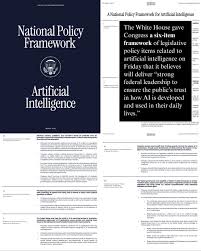
Now, the Trump administration has recently published the National Policy Framework on Artificial Intelligence. What does this mean for musicians, artists, creators, etc.? Should we be concerned?
Yes.
There are a few potential upsides. It offers some protection for likeness/misuse by taking measures against AI impersonation and exploitation. That could help with deepfake music, fake artist voices, and unauthorized likeness use. It could also offer more AI tools, enabling greater creative leverage. A pro-innovation stance means faster development of creative tools and more accessible AI for indie creators.
But this is a double-edged sword.
It should be noted that the National Policy Framework on Artificial Intelligence is not yet a law—it’s a set of recommendations to Congress. At a high level, it pushes for a single federal AI standard (overriding state laws), fewer restrictions on AI companies, and a focus on child safety, infrastructure, and U.S. competitiveness.
So far, it sounds good. And since it’s not yet law, it sets direction, not rules.
The big issue for creators is copyright & training data. This is the part that directly affects musicians, artists, and writers. The framework explicitly leans toward the view that AI training on copyrighted material is not illegal and suggests that courts decide rather than passing new protections. In practice, this means AI companies will be allowed to continue training on music catalogs, artwork, writing, etc., without guaranteed payment to or consent from rights owners.
Any claims of copyright infringement will result in ongoing lawsuits (by labels, authors, etc.). Translate this as meaning that your protection for your intellectual property will be determined entirely by court outcomes, not new legislation.
There are real risks embedded in this new move by the Trump administration.
1. Fewer guardrails on AI companies. The framework minimizes regulatory burden and tends to favor tech companies over rights-holders.
2. Blocking stronger state protections. Some states (like California, NY proposals, etc.) have been exploring stricter AI rules. The Trump administration’s framework pushes to override those state laws and could eliminate stricter protections for artists at the state level.
3. Regarding copyrights, instead of creating new licensing systems or royalties, it defers to courts, which creates expensive legal bills for rights holder plaintiffs, can take years to resolve, and in all likelihood, produce outcomes favoring corporate powers.
Music industry professionals see these directions as a Trojan Horse. Let’s take a closer look.
Section III, Respecting Intellectual Property Rights and Supporting Creators, states, “American creators, publishers, and innovators should be protected from AI-generated outputs that infringe their protected content, without undermining lawful innovation and free expression. “Although the Administration believes that training of AI models on copyrighted material does not violate copyright laws, it acknowledges arguments to the contrary exist and therefore supports allowing the Courts to resolve this issue. Similarly, Congress should not take any actions that would impact the judiciary’s resolution of whether training on copyrighted material constitutes fair use.”
The White House is taking a definitive position that training AI on copyrighted material does not violate copyright laws. This puts AI companies at an unfair advantage over creators and rights holders.
It continues: “Congress should consider enabling licensing frameworks or collective systems from rights holders to collectively negotiate compensation from AI providers, without incurring antitrust liability.”
This is not too bad; it is a good idea to have a collective organization to ensure compensation. But it does nothing to define the compensation framework. We have the right to use lawsuits to ensure compensation. But Congress has the power to regulate AI use, which could easily allow the misuse of creative content.
It continues.
“Congress should consider establishing a federal framework protecting individuals from the unauthorized use of AI-generated digital replicas of their voice, likeness, or other identifiable attributes, while providing clear exceptions for parody, satire, news reporting, and other expressive works protected by the First Amendment. Congress should prevent persons from abusing such a framework to stifle free speech online.”
Certainly, a federal framework to protect individuals should exist. But this begs the question of whether these images are more important than the controversy over AI companies releasing a torrent of songs, videos, or lyrics based on creative content that was, for all intents and purposes, stolen from content owners.
“Congress should continue to carefully monitor the development of copyright precedents and enforcement in the courts and evaluate whether, due to novel AI considerations, additional action beyond that proposed here is needed to fill potential gaps or provide additional protections for content creators.”
So, let’s say the class action lawsuits against Suno and Udio are won, and the court finds that there is no fair use, that they violated the DMCA (Digital Millennium Copyright Act), and that AI versions of songs infringed on copyrights. This means that only at that point should Congress consider the novel AI considerations.
In Section V, Enabling Innovation and Ensuring American AI Dominance, it says, “Congress should establish regulatory sandboxes for AI applications that help unleash American ingenuity and further American leadership in AI development and deployment.” “Congress should not create any new federal rulemaking body to regulate AI, and should instead support development and deployment of sector-specific AI applications through existing regulatory bodies with subject matter expertise and through industry-led standards.”
All of this, and other parts of the memorandum, means that the Trump administration is attempting to legalize intellectual property theft, provided that it puts the private AI corporations (which the Trump administration profits from) in a position of dominance over everyone else.
Nothing is changing immediately because it’s not the law. But the pro-tech industry, light regulation, and unresolved copyright protections clearly shape this legislation.
This framework is just the opening move. What matters next are court cases (music labels, authors, visual artists vs AI companies), whether Congress follows or resists this framework, and public pressure/industry lobbying. Many artists are organizing and influencing policy debates. The landscape has become legally uncertain, economically competitive, and politically contested.
The bottom line for artists & musicians is that the memorandum from the Trump administration is telling us, “We have no real interest in banning AI use of your work or protecting you from AI corporations stealing your work for AI training or any other purpose. We own you, and we can do whatever we want with you.”