

 Artist: SoSaLa
Titel: 1987 – Hajime
Format: CD and digital
Label: DooBeeDoo Records
Genre: NO WAVE, experimental, avant-garde, jazz, world
Stream here: https://soundcloud.com/sohrab-saadat-ladjevardi/sets/1987-hajime
Buy here: https://doobeedoobizllc.thrivecart.com/sosala-1987-hajime/
Website: www.Sohrab.info
By Dawoud Kringle
Hajime is a Japanese word meaning “beginning” or “start.” It is commonly used as a command in martial arts to begin a match, and as a masculine given name symbolizing a new chapter or the start of a month or period.
In 1987, SoSaLa released the LP ALEF “Hajime!” under his old artist name Sadato on his independent label, Kampai Records. “Alef” is the first letter of the Iranian and Arabic alphabet, symbolizing the beginning of SoSaLa’s music career.
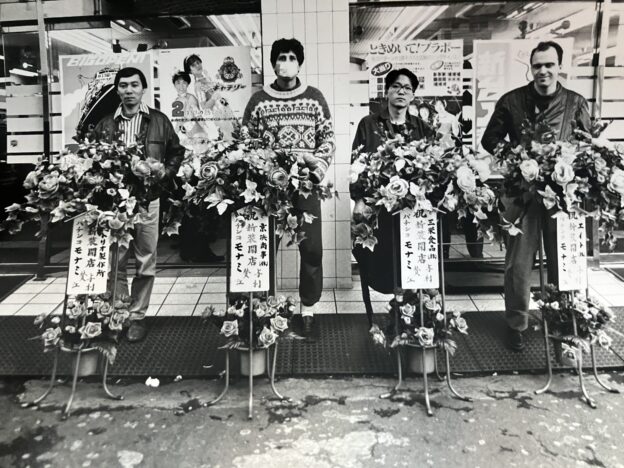
This retrospective album is another fascinating artifact for those interested in SoSaLa’s accomplished and innovative career. ALEF was a short-lived but pioneering multimedia performance group active in the mid-1980s, one that defined and transcended the Japanese free jazz-punk-noise scene of the era. SoSaLa’s recent re-releasing of his 1980s albums is akin to a public service as much as an artistic statement. This innovative and iconoclastic work should not be lost.
In addition to SoSaLa/Sadato (tenor and soprano saxophone, vocals, flute), the album features Tatsuya Ishida (drums & percussion), Hideki Kato (bass), and Dennis Gunn (guitar). Makeup artist Romi contributes a spoken-word performance in the Kyoto dialect on “Bachan No Tea Party” and Toshiko on synthesizer.
The album opens with “Sincro.” Shakers, a wailing flute, a guitar that treads the shamisen’s territory, and vocal chanting in a language no one outside the band understands create a terrifying invocation. It does not simply open the door—it ritualistically kicks it down with irresistible violence.
Not allowing the listener to recover, the next track, “Ningen” (the Japanese word for human being), begins with a salsa-like percussion and Sadato’s trademark vocalizing. A contemplative saxophone steps to the forefront while abstract guitar sounds lurk in the background as if looking for an opportunity to attack. After some speed‑oscillation hijinks on the vocals, the guitar finds its opening. The piece is dedicated to Diogenes of Sinope, the 4th‑century BC Greek philosopher and founder of Cynicism, who was known for carrying a lamp during the day to search for an honest man.
“Tsubana“ starts with the guitar making indistinct metallic noises that coalesce into a reggae/dub pattern, then are taken over and dissolved by a mournful flute melody. The guitar attempts to reassert itself, but decides to meet the flute on its own terms. Percussion dances in and out of the foreground. Throughout this apparent chaos, a groove somehow remains intact.
“Pachinko Breeze” (which SoSaLa describes as a song inspired by Japanese mechanical arcade and gambling games) begins with a harmonized saxophone that summons the ghost of Rahsaan Roland Kirk. An infectious groove emerges, drawing the listener into a desire to dance. The saxophone and guitar trade licks, clearly trying to out‑jazz each other while the drums and bass throw trickster rhythms at them in an effort to test their understanding of the groove. In the end, everyone wins.
An ominous discourse in Japanese (which, unfortunately, I have no translation for), accompanied by metallic percussion ejaculations, opens “Sarariman Shine.” This is less a song than an abstract sound painting, a polemic against the economic, social, and cultural conditions that gave rise to the Japanese “salaryman” subculture. Becoming a sararīman is a traditional path to prestige, representing financial security and a good life. The price is unwavering loyalty and commitment to one’s employer, prioritizing work over everything—including family. Long hours, obligatory socializing with colleagues and bosses, the sacrifice of individuality, and a willingness to be literally worked to death.
“Touche Pas A Mon Pote” (“Hands off my friend”) is Sadato’s tribute to SOS Racisme, a French left‑wing international movement of anti‑racist NGOs (which, though in decline since its 1987 peak, remains active today). As a foreigner in Japan who experienced discrimination, Sadato sympathized with the group. The track begins with the same abstracted textures as its predecessor. Then a pulse emerges, giving the saxophone and other instruments a foundation to express their political sentiments. At one moment, it becomes nearly impossible to distinguish the saxophone from the guitar. Whether this phenomenon was by design or one of those unexplainable accidents that occur in musical improvisation, it bears witness to the skill and communication between these musicians.
“Leila” (the Arabic word and female name meaning “night” or “black”) breaks the jarring mood of the two previous tracks with a beauty and lyricism one does not expect from this ensemble. Eventually, the group’s avant‑garde propensities emerge, and the song becomes a Lower East Side rock excursion. Yet somehow the poetic loveliness is not lost, even after it ventures into angry chaos.
The immersion into Asian sound painting returns in the very brief “Nanji desu ka” (“What time is it?”). The inclusion of this piece feels almost like a code that Sadato challenges the listener to decipher.
This continues as Sadato portrays the theatrical, cinematic image of an old geisha having tea in the sparse and onomatopoeic “Bachan No Tea Party.”
The album closes with “When I’m Crazy, I’m Normal.” This is Sadato’s tribute to – and personal identification with – Jim Morrison of The Doors, from what I consider Morrison’s greatest work: “The Celebration of the Lizard.” Sadato’s vocal emerges immediately and seamlessly after Romi’s part on the previous track, leaving the unsuspecting listener with the mistaken impression that it is part of the same song. This illusion is abruptly broken when the band launches into a driving psychedelic rock groove. The saxophone solo is melodic and, at the same time, an aggressive assertion of individuality in the face of opposition. The song moves through a series of startling changes in musical form, displaying a variety not heard elsewhere on the album. It is, in fact, a fierce and determined testimony to the Power of One. When the social order cannot or will not accept someone who refuses to conform, the individual must hold their ground and assert their own right to exist.
Sadato and his fellow musicians were, in addition to pioneering free jazz‑punk in a Japanese music scene that had no precedent for it, masters of ichion jobutsu. This translates as “one sound, achieving Buddhahood” – a quality in traditional Japanese music wherein the Zen Buddhist concept holds that a single, perfectly realized note contains the potential for spiritual awakening. It is the practice of producing a single tone as a meditative act, seeking enlightenment in the sound itself rather than in a sequence of notes. Sadato took this idea and fused it with a hybrid of Western musical forms. This band created something that never existed before, and may never exist again.
Previous Retro CD Releases
CD SoSaLa 1983 – Live at the Montreux Jazz Festival and the Rathausplatz Bern