
Music Review by Dawoud Kringle
Koubeh is the past, present, and future of Persian music.
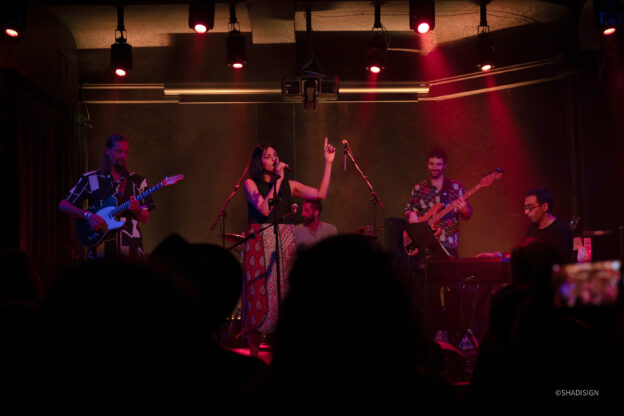
 The New York-based Iranian ensemble Koubeh formed in 2019 and consists of three musicians from the Iranian diaspora. They dedicated themselves to celebrating and reimagining Persian music for contemporary audiences.
Koubeh’s sound is rooted in the complex regional rhythms, nuanced melodies, and energetic arrangements of Persian musical traditions. It also carries a wide range of cross-cultural influences, including Balkan, Eastern European, Latin, reggae, and Afro-diasporic influences. Their skill, mastery, and sincerity create a vibrant cross-cultural sound that gives a voice to the modern Iranian diaspora.
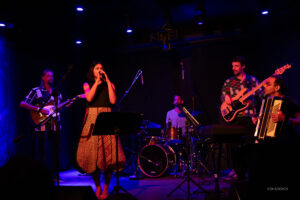
Koubeh is led by MFM member and former SoSaLa member Kaveh Haghtalab (drums, kamancheh), Sima Shahverdi (vocals), Nima Farzaneh (accordion, keyboards), Anders Nilsson (guitar), and Isaac Levien (bass).
Their single “Kook,” composed by Nima Farzaneh, has garnered an international following and generated over 10 million views on Instagram and over 1 million on YouTube. Their high-energy live performances have packed rooms with enthusiastic audiences and are growing a national following. Following a sold-out U.S. tour that packed rooms from San Francisco to New York, Koubeh has translated their explosive live energy into the studio.
Their new single, “Asemoon,” is rooted in Persian/Shirazi folk tradition. Kaveh Haghtalab played a central creative role in shaping Koubeh’s recorded version of “Asemoon.” While the song is rooted in older Persian folk tradition, Haghtalab arranged and directed a musically adventurous, yet very accessible and enjoyable new interpretation of the classic. The song has become one of the highlights of Koubeh’s live shows.
But how does this translate to a studio recording?
The song begins with an angular yet highly engaging figure. The joyful 6/8 feel of the rhythm immediately draws the listener into its groove.
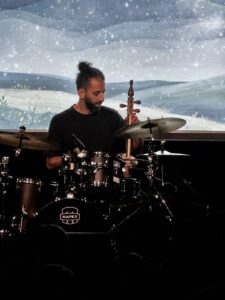 Haghtalab’s drumming is flawless. He effortlessly drives the complex Persian rhythm without being ostentatious or flashy, serving the song’s needs. Haghtalab and Levien share a seamless, conversational rapport. Nilsson’s understated yet effective guitar work completes the rhythm section triumvirate. Shahverdi’s vocals are a
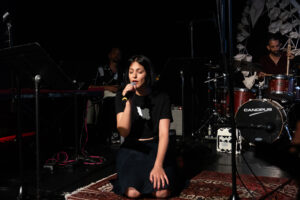
delight, easily navigating the demands of Persian music. Shahverdi delivers the music with authoritative ease, navigating Persian ornamentations while keeping the listener utterly grounded. Farzaneh’s accordion solo explores fascinating possibilities in the unfolding melodies and weaves in unexpected counterpoints with itself.
Their approach to reinterpreting traditional Persian music creates a powerful, dissonant tension. They use it as their raw material, but they are not bound by it. They are engaging in a dialogue with it, using the tools of jazz and Western harmony to ask new questions of an ancient form. Crucially, this harmonic friction never feels academic or cold; it merely adds a thrilling layer of depth to an immediately infectious groove.
I must comment about the accompanying music video. It was shot and directed by Shahryar Shahamat, and presented by Farhang Foundation (a member-supported, non-religious, non-political, not-for-profit organization established in 2008 to celebrate and promote Iranian art and culture). It is very well done, with shots of the band ranging from playing at The Bridge Studio to scenes in and around New York City, including many in the subways and a few in Prospect Park. There are several giddy hand-held movements and shots in which Shahverdi is prominently featured as the lead singer.
Director Shahryar Shahamat peppers the video with fleeting shots of birds against the New York skyline and someone pointing at them. A fitting visual motif, suggesting birds that hold special symbolic meaning in the song, grounding the urban landscape in Persian poetic symbolism. “Asemoon” (آسمون – the colloquial, spoken form of the standard Persian word آسمان – âsmân), translates into English as “sky,” “heaven,” “firmament,” or “celestial expanse.” This may provide a clue.
But it’s also good to enjoy the feel of the music. It stands on its own quite nicely.
With “Asemoon,” Koubeh doesn’t just preserve Persian antiquity—they reinvent its future. This is diaspora music at its most vital. In their hands, the music evolves without losing touch with its roots and essence.
PS: Kaveh’s “modern style” Kemancheh playing is featured on SoSaLa’s CD Nu World Trashed.
Interview: Koubeh – Revoicing Iranian Folk Music in Brooklyn