Text by Dawoud Kringle
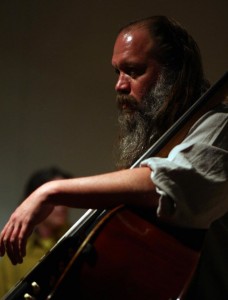 Once in a while, a true musical visionary emerges whose work redefines our perception of music, and how and why we make it. As a writer I am challenged to dig deep into my thesaurus to find adjectives adequate to the task of qualifying the work of a unique artist like Mark Deutsch. It is quite difficult to describe with words the astonishing psychic energy and breathtaking beauty of this music. One must experience it for oneself.
Mark Deutsch is a classically trained contrabassist and sitarist. In the late 1980s, Deutsch began exploring North Indian Hindustani classical music. His pursuits of this music, and work on sitar, inspired him to explore the mathematics of sound, particularly music’s underlying frequency structure. His sitar teacher, Ustad Imrat Khan, had told him that a westerner needed 20 years of study to properly hear the subtlety of intonation within Indian raga. He refused to accept this. So, he began to work out the mathematics of the musical intonation. He augmented this by playing recordings of Indian music in his sleep; especially recordings of the sarangi. His work revealed nonlinear mathematical patterns that exist in natural sound, the overtone series, fractals, the golden mean, and the Fibonacci series.
One night, he had a dream that he was playing sarangi on the contrabass. This was the initial inspiration that led to the design and construction of the Bazantar; an acoustic bass with additional sympathetic and drone strings. The instrument would take advantage of the nonlinear mathematical patterns found in sound. He began work on the first prototype of the Bazantar in 1993, and a finalized version was completed in October of 1997.
Continue reading →