DBDBD NY – cross-cultural on-line magazine – believes based on the view that music and community are indivisible that a social awareness can be fostered through music.
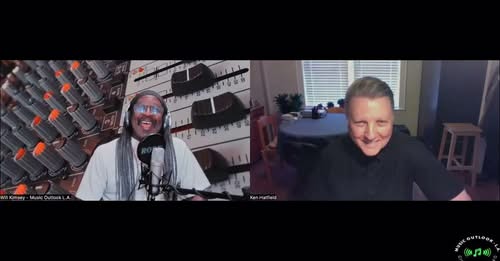
“My guest today is a master craftsman who has been described as ‘a veritable Picasso of the jazz guitar world.’ He is a virtuoso nylon-string guitarist, acclaimed composer, and brilliant educator who joined the faculty at the Berklee College of Music at just 19. With over a dozen celebrated books and albums, his genre-blurring voice has earned him the prestigious ASCAP Foundation Jazz Vanguard Award. But beyond his incredible fingerstyle technique and scores for ballet and the silver screen, he is also on the front lines, fighting for the future of independent music as a vital voice on the Freelance Musicians Association Jazz Advocacy Committee. Ladies & Gentlemen… this is Ken Hatfield…” – Will Kimsey (Podcast Host & Producer – Music Outlook L.A.)
DeepSeekis a privately owned artificial intelligence company based in Hangzhou, Zhejiang. It was co-founded by CEO Liang Wenfeng in 2023 and is owned and solely funded by Chinese hedge fund High-Flyer. During the last week of January 2025, DeepSeek released a generative artificial intelligence app called DeepSeek-R1.
Their app threw a monkey wrench into the machinery of the world’s economy.
The DeepSeek app has caused serious tech and finance ripples and threatened to render OpenAI obsolete. It accomplished this by offering its service for free (to be fair, OpenAI does have a free version), performing its most advanced tasks at the same level as OpenAI, sometimes beating OpenAI’s best models. To complicate matters for Western tech companies, it was developed for $5.6 million with GPUs that run at half the memory bandwidth. Additionally, DeepSeek’s models can distill other models to make them run better on slower hardware (“Distillation” is a means of extracting understanding from another model. One can send inputs to the teacher model and use the outputs to train the student model). This means that even a small computer like a Raspberry PI can theoretically run local Qwen models (a series of large language models developed by Alibaba Cloud. It is designed to understand and generate human-like text across various tasks). In other words, anyone can buy a GPU that fits in their pocket and fulfills at least some of their AI needs.
Since it’s publishing I’ve talked and discussed this post with various competent people. Here is one long and comprehensive comment by musician, composer and musician rights advocate Ken Hatfield which I want to share with you, my dear readers.
The U.S. House of Representatives embraced music licensing reform, and supported the efforts to update the US’ antiquated copyright laws.
The new Senate bill combines three separate pieces of legislation: 1. The Music Modernization Act of 2018 (S.2334, introduced by Senator Orrin Hatch (R-UT) and Senator Lamar Alexander (R-TN) in January, which updates licensing and royalties as pertains to streaming). 2. The CLASSICS Act (or Compensating Legacy Artists for their Songs, Service, & Important Contributions to Society Act, introduced in February by Chris Coons (D-DE) and John Kennedy (R-LA) to ensure that songwriters and artists receive royalties on pre-1972 songs). 3. The AMP Act (or Allocation for Music Producers Act, introduced in March by Senate Judiciary Committee Chairman Chuck Grassley (R-LA) and ranking committee member Dianne Feinstein (D-CA.) with the support of and Senators Bob Corker (R-TN) and Kamala Harris (D-CA).
Artist: Ken Hatfield Title: String Theory Label: Arthur Circle Music Genre: Classical / Contemporary Buy CD:cdbaby Review by David Belmont
I waited for Sunday morning to listen to this CD by Ken Hatfield again and write this review. While I think this music is enjoyable at other times as well, it seems to me particularly suited for the start of a relaxing day. A time I often reserve for Grant Green, Adrian Legg or Julian Bream. From the opening notes, it’s clear you’re listening to a master string player. His tone is full, his articulation precise. And while Hatfield’s technique is impressive, what’s striking is the emotional nuance of these very personal performances. The CD is made up of four multi-movement works, recorded in 2002-05. “The Gospel According to Sam” contains three duets between nylon string guitar and dobro which Hatfield dedicates to his father. This artful cross-genre blend runs seamlessly from old time country through various forms of pop and back again, and conjures up Hatfield’s Appalachian roots. He plays both the guitar and dobro parts. Their blend sounds so organic, it’s hard to believe they weren’t recorded at the same time. “Snowhill Variations” starts with an expressive neo-classical, followed by twelve variations. A beautiful journey on the solo nylon string guitar. Hatfield is back to duets in String Theory, these between his nylon string and mandolin. The title is a multiple entendre of many things, including (yes) modern physics. Hatfield combines the sharper, brighter mandolin tone with the warmer nylon sound to great effect. The record closes with the seven solo guitar movements of Borges and I, each titled for a particular short story by the Argentinian writer (as is the title of the suite). While continuing in a mainly classical vein, Hatfield blends in some jazz and pop ballad tonalities. Overall, this is a fantastic introduction to Hatfield’s music as well as a wonderful program in its own right. You can check more of his music at kenhatfield.com. One last note. Even in this digital age of streams and downloads, I recommend buying this CD in order to get the liner notes written by the artist, which are informative and entertaining.